

10 Things to Do Before Listing Your Home in Las VegasSelling a home isn't something I believe should begin the morning the For Sale sign goes into the yard.The work we do before your property hits

Dated: August 17 2026
Views: 14
Is Las Vegas Still a Great Real Estate Investment? What Buyers Should Know in 2026
If you're thinking about investing in real estate, one question I hear often is: Is Las Vegas still a great investment?
My answer is that Las Vegas can still be an attractive market, but today's investor needs to look beyond the headlines.
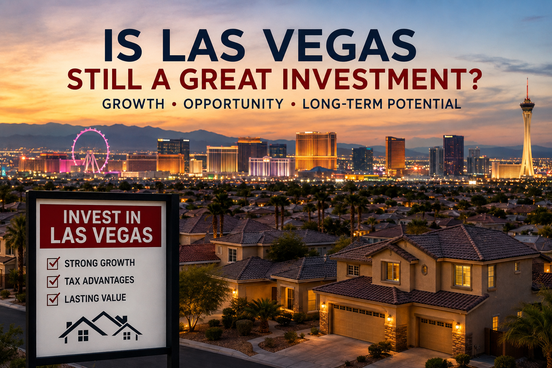
The Las Vegas housing market has changed. Buyers have more choices, sellers are having to compete more carefully, and price growth has cooled compared with the rapid appreciation we saw a few years ago. That doesn't necessarily make Las Vegas a bad investment. In fact, for the right buyer and the right property, a changing market can create opportunities.
As a Nevada REALTOR®, I believe the key is knowing what you're buying, where you're buying, and why the property makes sense for your long-term goals.
Las Vegas Is Still Growing
One of the biggest reasons I continue to pay attention to Las Vegas real estate is population growth.
Clark County's estimated population reached approximately 2.41 million in 2025, representing a 6.2% increase from the 2020 estimate base. The city of Las Vegas itself reached an estimated 679,817 residents in 2025, up 5.3% from 2020. (Census.gov)
Population growth doesn't automatically guarantee higher home prices, but it does create an important foundation for housing demand.
People need somewhere to live.
And as Las Vegas continues to attract new residents, buyers, workers, retirees, entrepreneurs, and businesses, different parts of the valley continue to evolve.
The Market Is More Balanced Than It Used to Be
This is where today's Las Vegas market is different.
Zillow reported an average Las Vegas home value of about $425,535 as of June 30, 2026, down 3.1% over the previous year. Realtor.com reported that active listings in Las Vegas were up 3.4% year over year in June, while the median list price was approximately $475,000. (Zillow)
For an investor, that tells me something important:
You don't have to chase the market.
There can be more room to compare properties, negotiate terms, evaluate potential rental income, and take your time deciding whether a deal actually makes financial sense.
That's very different from buying simply because you're afraid you'll miss out.
Las Vegas Has More Than Tourism
When people outside Nevada think about Las Vegas, they naturally think about casinos, hotels, entertainment, and tourism.
Tourism is certainly a huge part of the economy.
Las Vegas welcomed approximately 38.5 million visitors in 2025, along with nearly 6 million convention attendees. The LVCVA reports that tourism generated an estimated $80.9 billion in overall economic impact. (Las Vegas Visitors Authority)
But Las Vegas has also continued to diversify.
The regional economy includes healthcare, professional services, construction, logistics, education, manufacturing, finance, technology, sports, entertainment, and other industries.
That broader employment base is important when considering long-term housing demand.
The No State Individual Income Tax Advantage
Another reason Nevada continues to attract attention is its tax structure.
Nevada does not impose an individual state income tax on salaries, wages, or similar individual income. (Nevada Department of Taxation)
For people relocating from states with higher individual income taxes, this can be one factor in the overall financial appeal of living in Nevada.
Of course, taxes are only one part of an investment decision. Property taxes, insurance, HOA fees, maintenance, financing costs, vacancy, management expenses, and the purchase price all need to be considered before deciding whether a property is a good investment.
What About Rental Property?
Las Vegas can be interesting for investors looking at long-term rental opportunities.
But I would caution against buying a property simply because you assume it will "rent for a lot."
Rental income varies by neighborhood, property type, size, condition, amenities, and competition.
Before purchasing, I recommend looking at:
Then calculate the numbers conservatively.
A property that looks inexpensive at first glance isn't necessarily a good investment once all of the expenses are included.
Location Still Matters—A Lot
This is one of the biggest reasons I encourage investors to work with someone who knows the Las Vegas Valley.
Las Vegas isn't one single real estate market.
Summerlin, Henderson, Southwest Las Vegas, Northwest Las Vegas, North Las Vegas, Southern Highlands, Enterprise, and the areas surrounding the Strip can all behave differently.
A property near major employment centers may appeal to a different renter than a home near the Strip.
A single-family home in a master-planned community may have a completely different investment profile from a downtown condo.
And a luxury property may behave very differently from an entry-level home.
The ZIP code is only the starting point.
What About Buying a Home to Hold Long Term?
For buyers with a long-term horizon, Las Vegas can still be worth considering.
I personally prefer to look at real estate as a long-term decision rather than trying to predict what prices will do six months from now.
Markets go up.
Markets cool down.
Interest rates change.
Inventory changes.
Neighborhoods change.
The investors who tend to make thoughtful decisions are the ones who understand that real estate isn't always about timing the perfect moment. Sometimes it's about purchasing the right property at a reasonable price and holding it long enough for the investment strategy to play out.
That doesn't mean every property will appreciate or every investment will be profitable. It simply means the individual numbers and long-term plan matter more than a catchy market headline.
Las Vegas ZIP Codes Investors Should Know
If you're researching Las Vegas investment properties, here are several ZIP codes worth exploring:
Summerlin & West Las Vegas
89134, 89135, 89138, 89144, 89145
These areas can appeal to buyers looking for established master-planned communities, amenities, parks, shopping, and a strong residential lifestyle.
Southwest Las Vegas
89113, 89117, 89118, 89139, 89141, 89147, 89148, 89178, 89179
Southwest Las Vegas offers a broad mix of established neighborhoods, newer developments, townhomes, condos, and single-family properties.
Northwest Las Vegas
89128, 89129, 89131, 89149, 89166
Northwest Las Vegas provides a range of housing options and continues to attract buyers looking for suburban living and access to the growing northern part of the valley.
Central Las Vegas
89102, 89103, 89104, 89107
Central areas can offer different investment opportunities, particularly for buyers interested in established neighborhoods and proximity to Downtown Las Vegas.
Downtown Las Vegas
89101
Downtown has a very different investment profile from suburban Las Vegas, with condos, apartments, historic properties, entertainment, restaurants, and redevelopment all playing a role.
South Las Vegas
89123, 89183
These areas provide access to shopping, dining, transportation corridors, and growing residential communities.
Henderson
89011, 89012, 89014, 89015, 89044, 89052, 89074
Henderson deserves its own conversation because it offers a wide variety of residential communities and investment opportunities outside the Las Vegas city limits.
ZIP codes are useful for organizing your search, but they don't tell the whole story. Even within one ZIP code, property values, rents, HOA fees, neighborhood characteristics, and buyer demand can vary considerably. (USPS Tools)
What Are the Biggest Risks for Investors Right Now?
I don't believe in presenting Las Vegas real estate as a guaranteed investment.
There are risks.
Mortgage rates remain a major consideration. Inventory has increased, and home values have softened in some measures. Nationally, higher mortgage rates have also continued to limit affordability and transaction volume. (Reuters)
Investors should also consider:
The best investment isn't necessarily the cheapest property you can find.
It's the property whose numbers, location, condition, and long-term potential make sense together.
So, Is Las Vegas Still a Great Investment?
I think the better question is:
Is the particular Las Vegas property you're considering a good investment at today's price?
That's a much more useful question.
Las Vegas still has many of the fundamentals that attract real estate investors: population growth, a large and diverse metro area, substantial tourism and convention activity, ongoing development, a large employment base, and Nevada's favorable individual income-tax structure. (Census.gov)
At the same time, today's market requires more research than simply buying and hoping prices rise.
And honestly, I think that's a good thing.
A market where buyers have more time to investigate properties can reward careful decision-making.
Let Me Be Your Las Vegas Real Estate Resource
Whether you're purchasing your first investment property, building a rental portfolio, looking for a second home, considering a condo, or simply wondering what Las Vegas real estate looks like today, I'm here to help.
As a Nevada REALTOR®, I can help you look at properties from both a real estate and location perspective.
I'll help you compare neighborhoods, research comparable properties, understand market conditions, evaluate potential opportunities, and ask the questions that can make a difference before you purchase.
I'm also happy to help if you're not ready to buy yet.
Sometimes the smartest first step is simply understanding the market.
Las Vegas may still offer real estate opportunities—but the key in 2026 is not buying just because it's Las Vegas. It's finding the right property, in the right location, at a price that makes sense for your goals.
Real estate is an investment that carries risk, and past appreciation does not guarantee future results. Rental income, expenses, financing, taxes, HOA costs, and property values can change. Consult appropriate financial and tax professionals for advice specific to your situation.
10 Things to Do Before Listing Your Home in Las VegasSelling a home isn't something I believe should begin the morning the For Sale sign goes into the yard.The work we do before your property hits
Southern Highlands: Luxury Living with Small-Town Charm in Las VegasWhen people think about Las Vegas, they often picture bright lights, world-famous resorts, entertainment, and nonstop energy. But
The Hidden Costs of Buying a Home: What Buyers Should Know Before Making a MoveBuying a home is exciting.You find the neighborhood you love, walk through a house that feels just right, imagine where
The Complete Guide to Summerlin: Is It the Right Place for You?If you're considering a move to the Las Vegas area, chances are Summerlin has come up in your home search.And for good reason.Summerlin
Should you require assistance in navigating our website or searching for real estate, please contact our offices at 702-846-0159.


 The data relating to real estate for sale on this web site comes in part from the INTERNET DATA EXCHANGE Program of the Greater Las Vegas Association of REALTORS® MLS. Real estate listings held by brokerage firms other than this site-owner are marked with the IDX logo. The information being provided is for the consumers' personal, noncommercial use and may not be used for any purpose other than to identify prospective properties consumers may be interested in purchasing.
"GLVAR MLS
deems information reliable but not guaranteed."
© Copyright 2026 of the Greater Las Vegas Association of REALTORS® MLS. All rights reserved.
Show More...
